Comparing entry-level, semi-custom, custom cabinets

What’s the difference, and which one fits your Billings home?
“What’s the difference between semi-custom and custom?” We hear that question in our Billings showroom almost every week. It’s a fair one. From across the room, a lot of kitchen cabinets look alike. The differences show up in the details: how well they fit your space, how many choices you get, how long you’ll wait, and where your investment goes.
Here’s the plain-English version, followed by the way we explain it to clients sitting across the table from us.
The Three Cabinet Tiers at a Glance
Entry-Level Cabinets
Entry-level cabinets, often called stock cabinets, come in set sizes, usually in 3-inch width increments. Door styles and finishes come from a short, curated menu. When the cabinets don’t line up exactly with your walls, fillers close the gap. They’re the fastest to get and the most accessible investment.
Best for: rentals, flips, laundry rooms, garages, and projects where timeline matters most.
Semi-Custom Cabinets
Semi-custom is where a lot of our clients land. You start with a proven cabinet line and get real choices: more door styles, more finishes, and the ability to modify sizes, like adjusting depth, width, or height, so the layout fits your space better. Roll-outs, tray dividers, and drawer organizers are easy to add. Plus you can get custom drawings for individual cabinets as needed.
Best for: most kitchen and bath remodels, and homeowners who want a personalized look without the longest lead time and biggest investment.
Custom Cabinets
Custom cabinets are built to your exact measurements. Nearly any size, wood species, finish, or detail is on the table. Tall ceilings, odd angles, and walls that aren’t quite square aren’t a challenge, because every cabinet is made for your room.
Best for: forever homes, older homes with character, one-of-a-kind layouts, and statement kitchens.
Read the Window Sticker
Three cabinet tiers, compared like trucks on a lot.
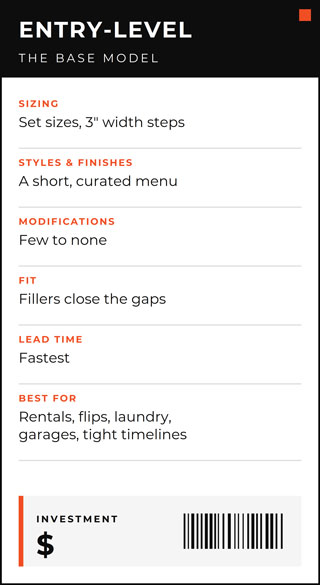
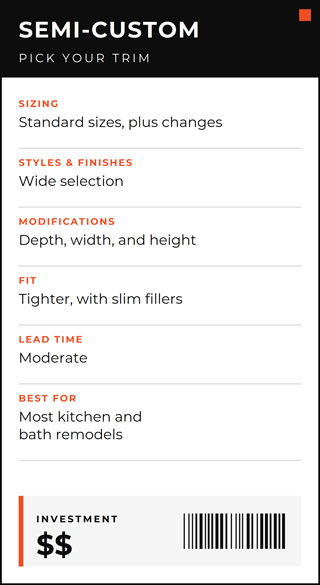
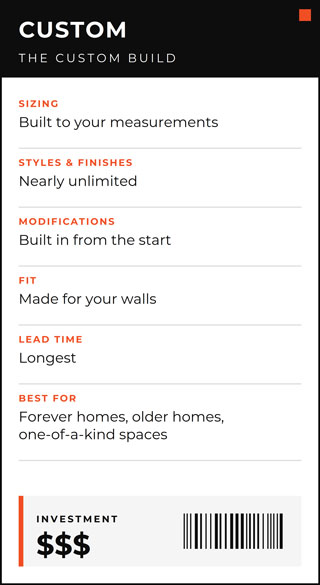
Entry-level, semi-custom, and custom cabinets compared side by side.
Think of It Like Buying a Truck
In the showroom, this is how we explain it.
Entry-level is the base model on the lot. It’s ready to go, it does the job, and what you see is what you get.
Semi-custom is picking your trim. You choose the color, the packages, and the options that matter to you. You’re still ordering from the factory menu, but it feels like yours.
Custom is the custom build. Every spec is your call, down to the stitching on the seats. It takes longer to show up, and it’s built exactly for how you’ll use it.
None of those is the wrong truck. The right one depends on where you’re driving and how long you plan to keep it. Cabinets work the same way.
How to Choose the Right Tier
These are the four questions we walk through with every client:
- How long are you staying? If this is your forever home, it may be worth putting more into fit and finish.
- How unusual is your space? Odd angles, soffits, sloped ceilings, and older walls lean toward semi-custom or custom.
- What’s your timeline? Entry-level moves fastest. Custom asks for the most patience.
- Where do you want your investment to show? Some spaces deserve the spotlight. Others need to work hard and look clean.
BTB Perspective
You don’t have to pick just one. Many of our kitchens mix tiers, like a semi-custom perimeter with a custom island or hood. It puts the investment where everyone looks and keeps the rest of the project on track.
Frequently Asked Questions
Are semi-custom cabinets good quality?
Yes. Quality depends more on the cabinet line and how it’s built than on the tier name. A well-built semi-custom line will outperform a poorly built custom cabinet every time.
Why do custom cabinets take longer?
Each piece is built to your specifications rather than pulled from a standard run. We’ll give you a realistic timeline for your project during the design process.
Can you mix cabinet tiers in one kitchen?
Absolutely. Pairing a semi-custom perimeter with a custom island or hood is one of the smartest ways to focus your investment.
Which cabinet tier is best for an older home in Billings?
Older homes often have walls that aren’t square and floors that aren’t level. Semi-custom modifications or custom cabinets usually handle that best, but the right call depends on the room.
Not Sure Which One Fits?
That’s what we’re here for. Come see all three in person during a complimentary showroom consultation. We’ll talk through how you live, what you want the space to do, and where your investment makes the biggest difference.
